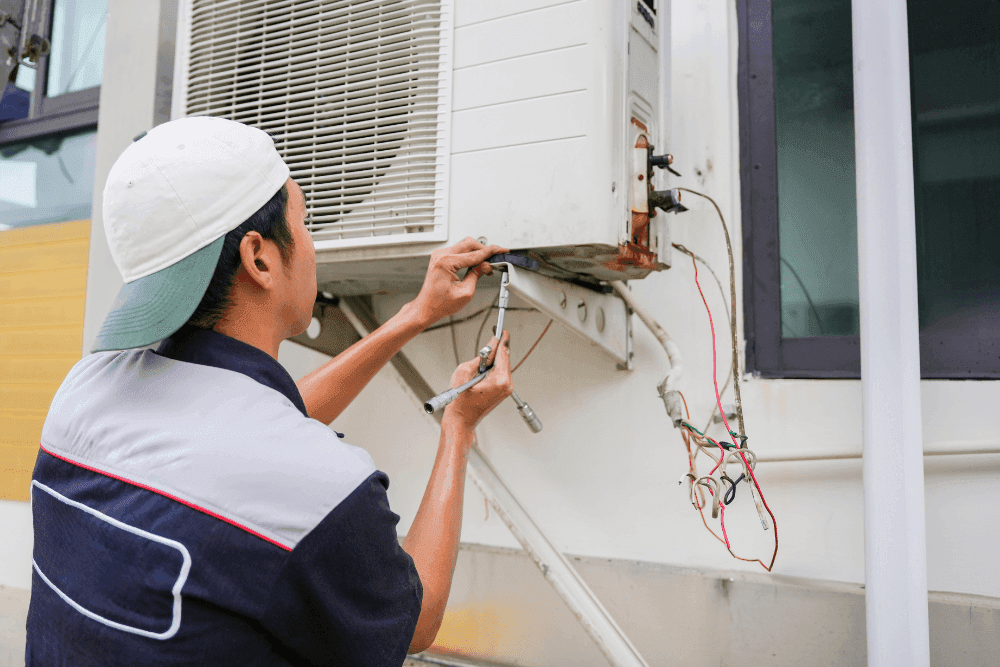
Every AC makes some sound — a steady, low hum from the outdoor unit and a soft whoosh of air indoors is completely normal. What's not normal is anything new, anything rhythmic or metallic, or anything that's gotten louder over the past few days. Seven distinct sounds account for nearly every noise complaint we get, and each one points to a specific cause with its own urgency level — some can wait for a normal booking, one means switching the unit off right now. Here's how to tell them apart.
A genuinely healthy split system sounds roughly the same every time it runs: the outdoor unit settles into a consistent low drone once the compressor and fan are up to speed, with no sharp edges to the sound, and the indoor unit produces mostly just airflow noise, air moving through the vents, with a barely audible whisper from the blower itself. If you can picture that baseline and what you're hearing right now is clearly different from it, something in the seven categories below is worth investigating — the difference is usually obvious once you're listening for it specifically, even if it's hard to describe out loud.
Quick reference: what each sound means
Use this to get a first read on urgency before the detail below. It's a starting point, not a diagnosis — several faults can sound similar, which is why a technician confirms the actual cause before quoting a repair.
| Sound | Likely cause | Urgency | Typical cost |
|---|---|---|---|
| Rattling, metallic shaking | Loose panel screws, degraded isolation feet, or debris in the outdoor unit | Medium | AED 150 – 350 |
| Buzzing or low electrical hum | Failing capacitor, most often — sometimes loose wiring | Medium-High | AED 250 – 550 |
| Banging or clanking | Broken fan blade or a failing compressor mount | Critical — switch off now | AED 400 – 2,000+ |
| Grinding or screeching | Dry or worn motor bearings | High — book same day | AED 300 – 800 |
| Repeated clicking on startup | Failing capacitor or relay struggling to start the unit | Medium | AED 200 – 500 |
| Hissing or bubbling | Refrigerant escaping from a leak — not a mechanical noise at all | High — book today | AED 350 – 900 |
| Whistling or whining | Almost always a blocked filter restricting airflow | Low-Medium | AED 100 – 300 |
Rattling, metallic shaking
- Likely cause
- Loose panel screws, degraded isolation feet, or debris in the outdoor unit
- Urgency
- Medium
- Typical cost
- AED 150 – 350
Buzzing or low electrical hum
- Likely cause
- Failing capacitor, most often — sometimes loose wiring
- Urgency
- Medium-High
- Typical cost
- AED 250 – 550
Banging or clanking
- Likely cause
- Broken fan blade or a failing compressor mount
- Urgency
- Critical — switch off now
- Typical cost
- AED 400 – 2,000+
Grinding or screeching
- Likely cause
- Dry or worn motor bearings
- Urgency
- High — book same day
- Typical cost
- AED 300 – 800
Repeated clicking on startup
- Likely cause
- Failing capacitor or relay struggling to start the unit
- Urgency
- Medium
- Typical cost
- AED 200 – 500
Hissing or bubbling
- Likely cause
- Refrigerant escaping from a leak — not a mechanical noise at all
- Urgency
- High — book today
- Typical cost
- AED 350 – 900
Whistling or whining
- Likely cause
- Almost always a blocked filter restricting airflow
- Urgency
- Low-Medium
- Typical cost
- AED 100 – 300
The 7 real causes of AC noise
1. Rattling — loose parts, not a serious fault
A metallic, rhythmic shaking that tracks with the fan speed is almost always something loose rather than something broken. The two most common causes: panel screws on the outdoor unit that have worked loose from years of vibration, and isolation feet — the rubber or foam pads the outdoor unit sits on — that have hardened and cracked, letting the metal casing vibrate directly against its mounting bracket instead of being cushioned. Debris caught in the outdoor unit's fan housing produces a similar sound, usually a faster, more irregular rattle rather than a steady rhythm.
This is one of the cheaper and lower-urgency faults on this list — worth booking normally rather than urgently, though a rattle left for months can eventually work a fan blade or panel loose enough to cause the far more serious banging fault below.
2. Buzzing or humming — usually a failing capacitor
A low electrical hum or buzzing drone, usually from the outdoor unit, most often traces back to a failing start capacitor — the small component that gives the compressor and fan motor the electrical surge they need to start spinning. As a capacitor ages and its capacitance drops, the motor draws extra current trying to compensate, and that extra electrical load produces the characteristic buzz. It's frequently accompanied by the AC struggling to reach its set temperature, since the compressor isn't starting as cleanly as it should.
A capacitor swap is a quick, inexpensive fix — but a buzzing AC genuinely shouldn't be left running for weeks. The extra current a struggling capacitor forces through the motor on every startup accelerates wear on the compressor itself, and a AED 300 capacitor replacement left unaddressed can eventually mean a AED 1,500+ compressor repair instead.
3. Banging or clanking — switch off immediately
This is the one sound on this list where the right first move is turning the unit off at the breaker before doing anything else, including finishing this paragraph. Banging from the outdoor unit almost always means a broken or fractured fan blade striking the casing on every rotation, or a compressor that's come loose from its mounts and is physically hitting the base tray. Banging from the indoor unit typically means a dislodged or broken blower wheel — the fan inside a wall or ceiling unit.
Every rotation the unit keeps running with a fault like this makes the physical damage worse and more expensive to fix — a fan blade replacement is a moderate repair; a fan blade that's been striking the coil for days can bend enough fins to meaningfully cut airflow and turn one repair into two.
4. Grinding or screeching — worn motor bearings
A sustained metal-on-metal grinding, or a high-pitched screech that rises and falls with motor speed, is the sound of bearings running dry. The motors in both the indoor blower and the outdoor condenser fan rely on lubricated bearings to spin smoothly, and once that lubrication is gone, metal runs directly against metal. Left running, this doesn't just get louder — the bearing surface itself gets scored, which turns a lubrication or bearing-replacement job into a full motor replacement.
This is worth booking the same day rather than waiting, specifically because the damage compounds quickly once bearings are actually dry rather than just under-lubricated.
5. Repeated clicking on startup
A single click when the unit starts or stops is completely normal — that's a relay or contactor switching. Rapid, repeated clicking as the unit tries and fails to start is different, and it's usually the same failing capacitor described above, or a faulty control relay. Each failed start attempt draws a spike of current trying to get the compressor moving, and repeated spikes like that are exactly what eventually damages compressor windings.
A rough but genuinely useful rule: if the AC clicks more than two or three times before it successfully starts, treat the capacitor as the likely cause and book it rather than waiting to see if it resolves on its own — it generally doesn't.
6. Hissing or bubbling — this isn't a mechanical noise at all
A persistent hiss from the indoor unit or the copper refrigerant lines, or a bubbling and gurgling sound inside the unit, means refrigerant escaping under pressure through a leak — gas physically forcing its way out through a small gap or joint. This is fundamentally different from every other sound on this list: it's not a loose part or a worn bearing, it's lost refrigerant, and it needs leak detection and a proper seal, not just a top-up.
Running an AC on low refrigerant makes the compressor work harder to maintain pressure, and refrigerant starvation is one of the more common paths to a full compressor failure — worth booking the same day rather than letting a slow leak run for weeks.
7. Whistling or whining — almost always the filter
A high-pitched whistle or steady whine from the indoor unit is, in the large majority of cases, air being forced through a badly clogged filter. As the filter loads up with dust, the narrowing gaps left for air to pass through create exactly this sound — the same physical effect as whistling through a narrow gap in your lips. It's also the easiest and cheapest thing on this entire list to check yourself.
If cleaning or replacing the filter doesn't resolve it, the next most likely cause on a ducted system is a gap or disconnection somewhere in the ductwork itself, letting air escape at higher pressure than it should.
Indoor unit or outdoor unit — narrowing it down first
Before matching a sound to a cause, it helps to know which half of the system it's coming from, since the two halves fail in different ways. The outdoor unit houses the compressor, the condenser fan, and the electrical components — capacitor, contactor, wiring — that start and run them, so most electrical noises (buzzing, humming, repeated clicking) and most fan-related noises (rattling, banging, grinding from the condenser fan motor) originate there. The indoor unit houses the evaporator coil and the blower fan that circulates air through the room, so grinding or screeching from the blower motor, and any hissing from the indoor coil or the refrigerant line connecting the two, show up there instead.
A simple way to narrow it down without opening anything: stand near the indoor unit and separately near the outdoor unit while the AC runs, and note where the sound is clearly loudest. On a ducted or concealed system where the indoor unit isn't directly accessible, whether the sound seems to travel with the airflow through the vents (indoor-side) or stays constant regardless of which room you're in (more likely outdoor, transmitted through the structure) is a reasonable substitute.
Why Abu Dhabi accelerates every one of these faults
Every fault above shares two accelerants, and Abu Dhabi supplies both harder than the climates most AC content is written for. Units here run for most of the year rather than a few summer months, often for 15-20 hours a day through peak summer — bearings that might last years of seasonal use wear out faster under that kind of near-continuous duty cycle, and a capacitor's rated operating hours get used up in a fraction of the calendar time they would in a milder climate.
The heat itself adds a second mechanism: metal components genuinely expand and contract more here, since the gap between a scorching midday outdoor temperature and an air-conditioned indoor one is wider than in most places these guides get written for, and that thermal cycling loosens screws, hardens rubber isolation feet, and stresses joints over time. Airborne dust and fine sand settle into filters and outdoor units faster too, which is why whistling from a clogged filter and rattling from ingested debris both show up more often here than the generic advice suggests.
Grid voltage can also fluctuate during periods of peak summer demand, when a large share of the city's AC load is running simultaneously — and voltage fluctuation stresses exactly the components behind the buzzing and repeated-clicking faults above. A capacitor already running closer to the edge of its rated life degrades faster under a voltage dip than it would under a stable supply, which is part of why capacitor failures cluster so heavily in peak summer months rather than spreading evenly across the year.
Apartment tower vs. villa: noise means something different
The same rattle or buzz is a genuinely different problem depending on where you live. In Abu Dhabi's high-rise towers — Al Reem Island, the Corniche, and similar developments — outdoor condenser units are frequently mounted on balconies or in shared service ducts, close to neighboring units and sometimes structurally connected to the building itself. A loose panel or degraded isolation feet here doesn't just annoy you — vibration can transmit through the wall or floor to a neighbor's unit, turning a routine repair into a noise complaint from someone else's apartment before you've even noticed it yourself.
In villa communities like Khalifa City, Al Shamkha, and Mohamed Bin Zayed City, outdoor units usually sit at ground level or on a roof with more physical separation from living spaces and neighboring properties, so the same fault is more of a personal annoyance than a shared-building issue — but roof-mounted units get less casual day-to-day attention, so a developing fault can run longer before anyone notices it. Worth mentioning your building type and whether the noise is bothering neighbors when you book — it changes both the urgency and what the technician checks first.
Does the noise pattern differ by brand?
To some extent, yes — the same fault sounds slightly different depending on the compressor and fan design, and a few brands common in Abu Dhabi have known tendencies worth knowing before you book.
- Daikin — inverter models run at variable speed rather than simple on/off, so a healthy Daikin's normal operating sound shifts pitch as it modulates. A steady, unchanging drone that doesn't vary with cooling demand is more likely a fault than on a fixed-speed unit, where constant sound is normal.
- Gree — a common source of repeated-clicking calls on older units, usually tracing back to the same capacitor pattern described above rather than anything Gree-specific.
- Carrier — when noise faults do occur, it's more often the capacitor or PCB producing an electrical buzz than a mechanical fan or bearing issue, consistent with Carrier's general reliability pattern on other faults.
- Mitsubishi — inverter and ducted models can produce a sensor-related error tone or erratic-sounding operation distinct from a genuine mechanical noise, since these units rely more heavily on continuous sensor feedback than fixed-speed models.
- O General — straightforward mechanical faults dominate; a rattle or buzz on these is more likely to be exactly what it sounds like — a loose panel or a capacitor — than something more complex.
- Midea — PCB-related electrical noise is worth testing for specifically on older Midea units, since their control boards are a known point of failure that can produce an unusual hum distinct from a simple capacitor issue.
None of this changes the core diagnosis — the seven sound categories above still apply regardless of brand — but mentioning your AC's brand when you book can help a technician narrow down the likely cause slightly faster.
What's safe to check yourself
- Check and clean the filter first. Resolves whistling in most cases, and it's the fastest, cheapest thing on this list to rule out.
- Look for debris in the outdoor unit, power off first — leaves, plastic, or dust clusters caught in the fan housing.
- Press lightly on accessible panels to see if the sound changes — a loose panel is a simple fix once confirmed.
- Note whether the sound is constant or only at startup — clicking specifically at startup points toward the capacitor; a constant hum or buzz while running points there too, just with a different pattern.
- Count clicking attempts before the unit starts, if that's what you're hearing — more than two or three is a genuine capacitor warning sign, not just an odd startup.
What not to do: don't open the outdoor unit's casing or touch any internal component beyond clearing visible external debris with the power off. Bearings, capacitors, refrigerant lines, and compressor mounts all need a technician — none of them have a safe consumer-level fix the way filter cleaning does.
When to switch off immediately
- Banging or clanking, particularly from the outdoor unit — this means a physically broken component striking other parts, and every rotation makes the damage worse.
- Any noise alongside a burning smell — treat this as an electrical fault, not a routine noise complaint.
- Grinding that's clearly worsening over hours, rather than a steady, unchanged screech you've been hearing for days.
- A hiss or bubbling sound alongside noticeably weaker cooling — active refrigerant loss combined with the compressor working harder to compensate.
Outside of these, most noise faults can wait for a normally scheduled visit rather than needing an emergency call-out — rattling and whistling specifically are rarely urgent even though they're audible and annoying.
One judgment call worth spelling out: if you're unsure whether what you're hearing counts as "banging" or just an unusually loud rattle, treat it as banging and switch off. The cost of being wrong in that direction is a few minutes without cooling while you call someone; the cost of being wrong the other way — leaving a genuinely broken component running — is a repair that gets more expensive by the hour.
What AC noise repair costs in Abu Dhabi
Pricing below is consistent with the ranges published on our main AC repair page — not a fixed quote for your specific unit. You'll get an exact price on-site after diagnosis, and a technician tests the actual cause (capacitor, bearing, fan blade) before quoting rather than pricing from the sound description alone.
| Repair | Typical cost | Notes |
|---|---|---|
| Loose panel / isolation feet replacement | AED 150 – 300 | The most common fix for rattling |
| Capacitor replacement | AED 250 – 450 | Fixes buzzing and most repeated-clicking faults |
| Fan blade replacement | AED 350 – 600 | For banging caused by a broken outdoor fan blade |
| Compressor remount / mounting repair | AED 300 – 700 | When banging is from a loose compressor, not the fan |
| Motor bearing replacement | AED 300 – 800 | For grinding or screeching — indoor or outdoor motor |
| Refrigerant leak find & seal + top-up | AED 350 – 900 | For hissing or bubbling — depends on refrigerant type and leak location |
| Filter clean / replace | AED 50 – 150 | Resolves most whistling on its own |
Loose panel / isolation feet replacement
- Typical cost
- AED 150 – 300
- Notes
- The most common fix for rattling
Capacitor replacement
- Typical cost
- AED 250 – 450
- Notes
- Fixes buzzing and most repeated-clicking faults
Fan blade replacement
- Typical cost
- AED 350 – 600
- Notes
- For banging caused by a broken outdoor fan blade
Compressor remount / mounting repair
- Typical cost
- AED 300 – 700
- Notes
- When banging is from a loose compressor, not the fan
Motor bearing replacement
- Typical cost
- AED 300 – 800
- Notes
- For grinding or screeching — indoor or outdoor motor
Refrigerant leak find & seal + top-up
- Typical cost
- AED 350 – 900
- Notes
- For hissing or bubbling — depends on refrigerant type and leak location
Filter clean / replace
- Typical cost
- AED 50 – 150
- Notes
- Resolves most whistling on its own
Preventing it
Most of these faults are wear-and-tear issues that an annual service catches before they turn into an audible complaint — a technician checking capacitor readings, panel fastenings, isolation feet, and bearing condition during routine maintenance finds a degrading capacitor or a loosening panel well before it starts buzzing or rattling. An AC Maintenance / AMC contract puts this on a schedule rather than leaving it until something's already audible.