Preventive Care, Not Just Fixes
AC Maintenance & AMC
Scheduled servicing before the breakdown — for split, window, and central systems, with annual contracts available so you're not scrambling in peak summer.

What a Maintenance Visit Actually Covers
Filter check and clean
Every 4-6 weeks during peak summer use — a dirty filter is the single most common cause of reduced cooling we see, and the cheapest to prevent. A clogged filter forces the whole system to work harder to move the same volume of air, which shows up as both weaker cooling and a higher electricity bill long before it shows up as an obvious fault.
Coil and drain pan inspection
Catches early mold growth and drain blockages before they become a musty smell or a water leak indoors. The evaporator coil sits cold and wet by design, which makes it the one component in the system most prone to biological growth if it isn't checked regularly.
Refrigerant pressure check
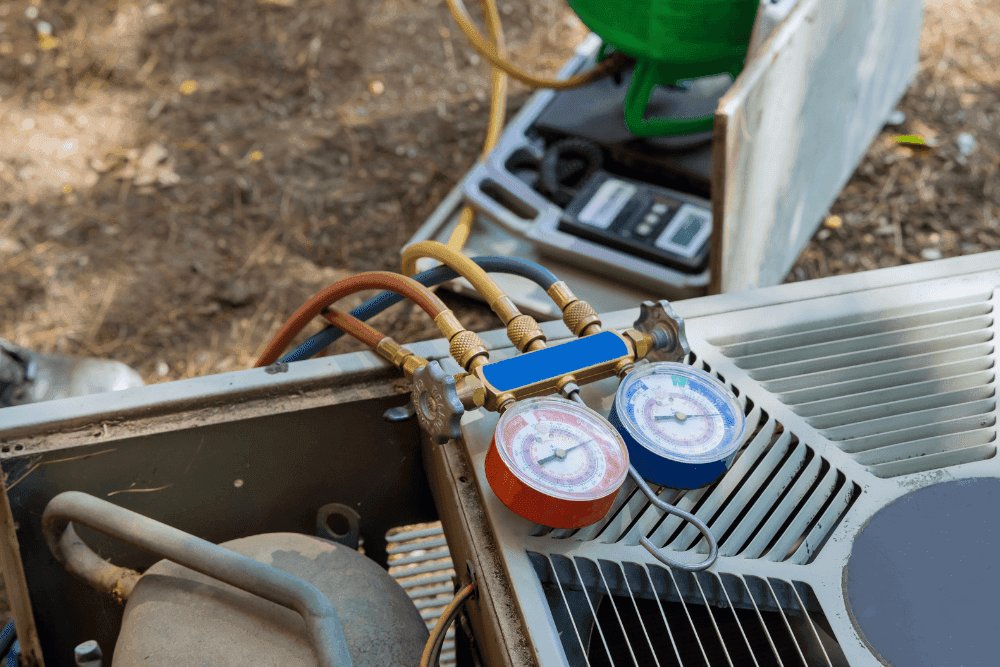
A slow refrigerant leak often shows up as a pressure reading below spec well before cooling performance visibly drops — catching it here prevents a compressor working harder than it should for months before the fault becomes obvious to the household.
Electrical and capacitor check
Worn capacitors and loose electrical connections are a common cause of a unit that trips breakers or fails to start — caught early, this is a small fix rather than an emergency call-out on the hottest day of the year, which is exactly when capacitors tend to fail under the heaviest load.
Outdoor unit and condenser check
Debris, dust buildup, and fan motor wear on the outdoor unit reduce heat exchange efficiency — often invisible from indoors until cooling performance drops. Clearance around the outdoor unit matters too; anything blocking airflow forces the compressor to work against restricted ventilation.
Thermostat calibration check
A thermostat reading even a couple of degrees off makes the whole system run longer than necessary to reach a temperature it thinks hasn't been hit yet — a quiet, easily overlooked source of both discomfort and unnecessary compressor wear.
Ductwork and register inspection (central systems)
Loose duct connections, damaged insulation, or partially closed dampers reduce delivered airflow to individual rooms — a factor separate from ductwork cleanliness, and one general servicing checks alongside the cleaning-specific work.
Why an AMC Makes Sense
Predictable annual cost
An AMC bundles scheduled visits into one fixed price, rather than each visit being a separate decision and separate invoice — useful for budgeting, especially across multiple units in a villa.
Priority scheduling in peak season
AMC customers get scheduling priority during the summer rush, when non-contract bookings can face longer wait times simply from volume of demand across the city.
Faster fault detection
A unit seen twice a year has faults caught while they're still small and cheap — a scheduled relationship with a technician who's already familiar with your specific units tends to catch developing issues a one-off call-out wouldn't.
AMC Pricing
Contracts are priced per unit or per property, not as a flat one-size fee — a single split unit and a five-unit villa are genuinely different jobs.
Split AC — per unit
AED 300 – 600 / year
2 scheduled visits per unit, before and after summer
Central / ducted system
AED 800 – 1,500 / year
Per system, based on ductwork size and access
Villa multi-unit package (5+ units)
AED 2,000 – 4,000 / year
Bundled rate across all units on the property
Call for an exact quote based on your number of units, system type, and property size.
The Abu Dhabi AC Maintenance Calendar
March – April (pre-summer)
The most important visit of the year. Full checklist pass before peak demand hits — this is when a small fault is cheapest and easiest to fix, and when technician availability is still good.
June – August (peak summer)
Units run near-continuously. If your AMC includes a mid-summer check, this is where it happens — but even without one, this is the period to act immediately on any symptom rather than waiting.
September – October (post-summer)
A second full check for units that ran hard through summer, catching wear before the lighter winter season masks a developing fault that would otherwise surface unexpectedly next spring.
Signs Maintenance Has Been Skipped Too Long
- Cooling that used to feel strong now feels noticeably weaker
- Electricity bills creeping up without a clear explanation
- A faint but persistent smell that wasn't there a year ago
- The unit runs longer than it used to for the same room temperature
- It's genuinely been over a year since anyone looked at the system
- You've never had the outdoor unit checked, only the indoor side
Timing Matters More for AC Than Most Appliances
A pre-summer check in March or April catches faults while technicians are still readily available — book after the first heat wave hits in May or June and you're competing with every household in the city for the same limited slots, often waiting days for a routine check that would have taken an hour a month earlier.
A second check in autumn is worth it too, particularly for units that ran near-continuously through summer — catching wear before winter's lighter use masks a developing fault.
The economics work in your favor either way: a capacitor caught during a scheduled March visit is a small, planned repair. The same capacitor failing in July, mid-heatwave, with every technician in the city booked solid, is both a more urgent problem and a less convenient one to solve.
Maintenance Is Broader Than Cleaning
It's easy to conflate the two, but they're different in scope. Cleaning addresses dust, mold, and airflow restriction specifically — filters, coils, and ductwork. Maintenance includes cleaning as one component, but adds everything electrical and mechanical: capacitor condition, refrigerant pressure, thermostat calibration, and outdoor unit inspection.
A system can be spotlessly clean and still have a refrigerant leak developing, or a capacitor a season away from failing — which is exactly why a full maintenance visit catches things a cleaning-only visit wouldn't. If you're only interested in the cleaning half, that's a real, separate service worth booking on its own.
See our AC Cleaning & Duct Cleaning page →Split Units vs. Central Systems — What Changes
The core checklist is the same regardless of system type, but central and ducted systems add the air handler and ductwork itself to the inspection — checking damper positions, duct connections, and insulation condition alongside the standard filter, coil, and electrical checks.
Multi-unit villas with several split systems benefit from having all units checked in one scheduled visit rather than piecemeal, both for convenience and because a technician already on-site can compare performance across units and flag one that's noticeably underperforming relative to the others — a comparison that's harder to make from separate, unrelated call-outs.
How a Maintenance Visit Is Structured
Filter and airflow check
Every visit starts here since it's the fastest thing to check and the most common source of a developing problem — a clean filter with good airflow rules out the most frequent cause of reduced performance immediately.
Coil, drain pan, and refrigerant pressure
The indoor coil and drain pan are inspected and cleared as needed, and refrigerant pressure is checked against expected range for your specific unit and refrigerant type.
Electrical and capacitor test
Capacitor condition, wiring connections, and general electrical integrity are checked — this is where a fault that would otherwise surface as a mid-summer breakdown gets caught early.
Outdoor unit inspection
Condenser coil condition, fan motor operation, and clearance around the unit are all checked — often the most overlooked part of the system since it's rarely visible day to day.
Report and recommendations
You get a plain summary of what was checked, what's in good condition, and what — if anything — is worth watching or scheduling a repair for, rather than a vague 'all good' with no detail.
What You Can Handle Yourself Between Visits
Filter checks are genuinely a DIY task, and doing them monthly between professional visits is one of the highest-value things a household can do for AC performance. Beyond that, though, the checklist above needs equipment and training a homeowner doesn't have on hand — refrigerant pressure gauges, capacitor testing equipment, and the experience to recognize when a reading is subtly off rather than obviously broken.
The gap between "looks fine" and "is actually fine" is exactly where scheduled professional maintenance earns its cost — a unit can look and sound completely normal while a capacitor is a month from failing or a refrigerant leak is slowly worsening, neither of which is something you'd notice without the right equipment.
What a Genuine AMC Should Include
Not every AMC on the market covers the same ground, and it's worth knowing what to expect before signing one. A contract that's only filter cleaning dressed up as "maintenance" isn't doing the job the full checklist above covers — electrical, refrigerant, and outdoor unit checks matter as much as filter and coil cleanliness, and a genuine AMC includes all of it, every scheduled visit, not just the cheapest parts.
Worth asking directly: how many visits per year, what's checked at each one specifically, and what happens — in terms of pricing and scheduling — if a fault is actually found. A provider that can't answer these plainly probably hasn't thought through the contract as carefully as you're about to commit money to it.
Scheduled Maintenance and Manufacturer Warranties
Many manufacturer warranties on AC units carry maintenance requirements in the fine print — a compressor warranty, in particular, sometimes requires documented regular servicing to remain valid, since manufacturers reasonably don't want to cover failures caused by neglect rather than a genuine manufacturing defect.
Keeping a documented maintenance history protects you either way — if a warranty claim ever comes up, having records of regular servicing removes any question about whether neglect contributed to the fault, which can otherwise complicate or delay a legitimate claim.
Not Every Unit Needs the Same Schedule
A bedroom unit running mostly overnight sees genuinely less wear than a majlis or living room unit running most of the day during summer — both matter, but the higher-use unit benefits from a shorter check interval than the twice-a-year baseline.
The same logic applies to units in rooms with higher occupancy or activity — a home office running an AC continuously through a working day accumulates the same wear pattern as a commercial space would, just at residential scale, and is worth flagging as a priority unit within a multi-unit maintenance visit rather than treating every unit in the property identically.
Villas and Apartments With Multiple Units
Larger villas often run 5-10 separate split units across different rooms, each with its own compressor, capacitor, and refrigerant charge — meaning each is genuinely a separate system that can fail independently of the others. Scheduling all units in one visit rather than reacting to each individually as it develops a problem is both more convenient and more cost-effective per unit than the same number of separate call-outs spread across the year.
A Concrete Example of Why Timing Matters
A capacitor caught during a March maintenance visit is a straightforward, inexpensive replacement — the technician's already on-site, the part is common, and the whole thing takes minutes as part of a scheduled visit you were paying for anyway.
The same capacitor, left unchecked, typically fails under the exact conditions that stress it most — a hot July afternoon, during peak compressor load. Now it's an emergency call-out rather than a scheduled visit, competing for a technician's time against every other household having the same problem in the same heatwave, on a system that's now sitting completely non-functional rather than running at reduced but tolerable performance.
The part costs the same either way. The difference is entirely about when the problem gets found, and that timing is the whole value proposition behind scheduled maintenance over reactive repair.
Frequently Asked Questions
What's included in an AC maintenance visit?
How often should I get my AC serviced in Abu Dhabi?
What is an AMC, and is it worth it?
How much does an AC maintenance contract cost in Abu Dhabi?
Can maintenance actually prevent a breakdown, or is it just cleaning?
Do you offer AMC for multiple units — a whole villa or apartment?
Is maintenance different for central/ducted systems versus split units?
If something's actually broken, is that still a maintenance visit?
How long does a maintenance visit take per unit?
Will regular maintenance actually save me money, or is it an extra cost?
Does an AMC cover parts if something needs replacing during a visit?
Can I start an AMC mid-year, or only at the start of a new season?
Do you offer AMC for commercial properties too?
What happens if a fault is found during a scheduled maintenance visit?
Is maintenance different for AC than for other appliances?
Does maintenance help with electricity bills, or just prevent breakdowns?
Can I combine an AC AMC with maintenance for my other appliances?
Ready When You Are
Book your pre-summer AC check now.
Fixed price confirmed before any work starts. Licensed technicians, 90-day workmanship warranty.