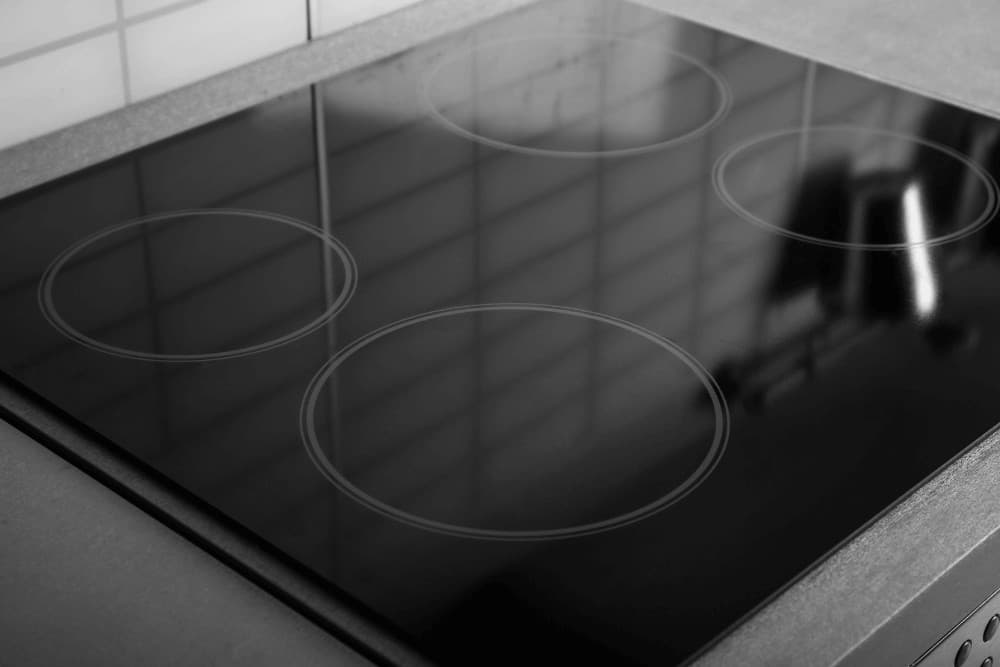
A crack in an induction hob rarely means the whole appliance is finished — but it does mean moving carefully, and most of the advice online skips the step that actually matters first: confirming whether what you're looking at is a crack at all, or something that only looks like one. Get that wrong in either direction and you either keep cooking on a genuine safety hazard, or book an expensive glass replacement for a mark a five-minute check would have ruled out. Here's how to tell the difference, why induction glass behaves differently from a basic ceramic or coil stovetop when it's damaged, what the DIY "crack repair kits" in search results actually do and don't fix, and what real replacement costs and timelines look like in Abu Dhabi specifically.
Crack, Chip, or Just a Mark? The 3-Minute Test
Not everything that looks like a crack on an induction hob is one. Hard water deposits, a hairline scratch that's caught grease and gone dark, or a shadow under the glass from a discoloured element can all look identical to a real fracture under kitchen downlighting — especially on black glass, where every mark reads the same until you look at it properly. Before assuming the worst, run these three checks.
| Test | How to do it | What it tells you |
|---|---|---|
| Raking light test | Turn off the hob and let it cool. Hold a torch or phone flashlight flat against the glass, almost parallel to the surface, and sweep it slowly across the mark. | A true crack catches the light and throws a fine, continuous shadow line, even where the mark looks faint from above. A stain or scratch won't cast that shadow — it looks the same from every angle. |
| Fingernail catch test | Run a fingernail gently along the mark, cold hob only. | A crack has a physical edge you can feel catch, even slightly. A stain or light scratch feels flush with the surrounding glass. |
| Cold water test | Wipe a few drops of water across the mark and watch what happens over 30 seconds. | Water that visibly seeps into or darkens along the line indicates an actual break in the glass. Water that beads and sits on top, unchanged, points to a surface-level mark only. |
Raking light test
- How to do it
- Turn off the hob and let it cool. Hold a torch or phone flashlight flat against the glass, almost parallel to the surface, and sweep it slowly across the mark.
- What it tells you
- A true crack catches the light and throws a fine, continuous shadow line, even where the mark looks faint from above. A stain or scratch won't cast that shadow — it looks the same from every angle.
Fingernail catch test
- How to do it
- Run a fingernail gently along the mark, cold hob only.
- What it tells you
- A crack has a physical edge you can feel catch, even slightly. A stain or light scratch feels flush with the surrounding glass.
Cold water test
- How to do it
- Wipe a few drops of water across the mark and watch what happens over 30 seconds.
- What it tells you
- Water that visibly seeps into or darkens along the line indicates an actual break in the glass. Water that beads and sits on top, unchanged, points to a surface-level mark only.
If two of these three point to a genuine crack, treat it as one and skip to the safety section below — don't keep testing hoping for a different answer. If all three come back negative, you're most likely looking at a stain, scratch, or a shadow from something under the glass, and none of those need the hob switched off; they're a cleaning or cosmetic issue, not a safety one.
One more distinction worth making before going further: a chip and a crack aren't the same fault, and they don't carry the same risk. A chip is missing material — a small piece has come away from an edge or corner but hasn't propagated into a line across the glass. A crack is a fracture that runs, and can keep running under heat and pressure even if it looks stable today. Chips confined to the very outer edge, away from any cooking zone or the touch controls, are lower-risk than a crack of any size — but "lower-risk" isn't "no action needed," which the next section explains.
Why a Cracked Induction Hob Is Riskier Than a Cracked Ceramic or Coil Stove
Most advice online lumps every glass cooktop together, but induction hobs have two things underneath the glass that a basic ceramic-topped resistance stove or an old-style coil stove don't: an electromagnetic induction coil for every cooking zone, and a capacitive touch-sensor circuit board running the controls — both sitting within a few millimetres of the glass surface, not behind a layer of insulation the way a coil element is.
That proximity is why the standard advice — "unplug it and it's fine to leave alone" — doesn't fully apply to induction. A crack that lets even a small amount of moisture reach the coil or the PCB during cleaning or a boil-over can cause a short, a control fault, or in rarer cases a fire risk, independent of whether the appliance is switched on at that exact moment, since residual moisture ingress is a problem the next time it's powered up, not only while it's running.
| Cooktop type | What's directly under the glass | Risk if cracked |
|---|---|---|
| Induction | Electromagnetic coils + capacitive touch PCB, both close to the surface | Moisture ingress can damage the coil or control board even when the appliance is off; highest risk category |
| Ceramic (radiant / halogen) | Resistance heating elements under a ceramic-glass sheet | Lower electronic risk, but the element itself can be damaged by moisture or impact; still a shock risk once cracked |
| Coil / solid plate | Exposed metal elements, no glass surface at all | Not applicable — this is the one type where cracked glass isn't a relevant fault |
Induction
- What's directly under the glass
- Electromagnetic coils + capacitive touch PCB, both close to the surface
- Risk if cracked
- Moisture ingress can damage the coil or control board even when the appliance is off; highest risk category
Ceramic (radiant / halogen)
- What's directly under the glass
- Resistance heating elements under a ceramic-glass sheet
- Risk if cracked
- Lower electronic risk, but the element itself can be damaged by moisture or impact; still a shock risk once cracked
Coil / solid plate
- What's directly under the glass
- Exposed metal elements, no glass surface at all
- Risk if cracked
- Not applicable — this is the one type where cracked glass isn't a relevant fault
In practical terms, a cracked induction hob deserves faster action than a cracked basic electric stove with exposed coils, even though the visible damage might look identical. It also means the DIY fixes aimed at "glass cooktops" in general — the kind covered in most US and UK appliance blogs — need to be read with induction specifically in mind, which is where the next section gets more specific than most of what's out there.
There's also a diagnostic wrinkle specific to induction worth knowing about: the fault an impact causes isn't always visible as a crack at all. Because the coils sit so close to the glass, a hard enough knock can shift or damage a coil's positioning or connection without breaking the surface, which shows up as a zone that won't detect cookware, cycles on and off unprompted, or throws an unfamiliar error code — with the glass looking completely intact. If a hob starts misbehaving shortly after being dropped on, bumped, or having something heavy set down on it, treat that as worth a diagnostic visit even with no visible crack, rather than assuming a fault with no mark on the glass must be unrelated to the impact.
Can You Actually Repair It? What Crack-Repair Kits Really Do
Search for "glass cooktop crack repair" and you'll find two contradictory answers from equally confident-sounding sources: some walk through a filler-paste-and-hardener method step by step as if it's a standard fix, while others flatly say cracked glass can't be repaired and must be replaced. Both are describing the same category of kit — the difference is what they're actually being used for, and neither source usually says so.
Cosmetic touch-up kits — the buffing creams and glass-polish pastes marketed for light scratches and burnt-on residue — genuinely work for what they're designed for: surface-level marks with no depth to them. Buffing out a scratch that failed the fingernail-catch test above is a reasonable DIY job.
The filler-paste-and-hardener kits marketed as "crack repair," by contrast, are epoxy or resin products, and epoxy has a heat tolerance nowhere near what an induction hob's glass surface cycles through during normal cooking — repeated swings from room temperature to well over 200°C directly above the crack. That thermal cycling breaks the epoxy's bond within a handful of uses, at which point there are two problems instead of one: the original fracture, now hidden under a compound that's flaking and potentially adding debris into the crack itself, plus a false sense that the hob has been fixed.
On a basic ceramic or coil stove, a failed epoxy repair is mostly a cosmetic disappointment. On induction it's a worse outcome, specifically because of the coil-and-PCB layer described above — a flaking filler compound sitting over a crack doesn't change whether moisture can still reach the electronics underneath, and it can make a later professional inspection harder, not easier, because a technician now has to remove the compound before properly assessing how far the fracture actually runs.
There's no version of a filler kit, glue, tape, or sealant that changes this. If the tests above confirm a genuine crack, treat "repair" as meaning glass replacement, not concealment — and treat any product marketed specifically as a "crack fix" for a glass cooktop with the same skepticism you'd apply to a windscreen-repair kit claiming to fix a crack that's spread across the whole windscreen. Some damage genuinely is replace-only, and a hob with active electronics under a fractured surface is squarely in that category.
Chips are a slightly different story. A small edge chip that hasn't propagated into a crack — confirmed using the tests above — can sometimes genuinely be smoothed rather than replaced, since there's no fracture line for moisture to travel along. That's a judgment call worth having a technician make in person rather than deciding from a phone photo, since what looks like an isolated chip from above can have a hairline crack radiating from it that's only visible under raking light.
When It's Small Enough to Leave Alone — and When It Isn't
Blanket advice tends to sit at one of two unhelpful extremes: "never use it again" regardless of how minor the mark is, or the kind of forum post where someone taped over a crack and used the hob for two years without incident. Neither is a genuinely useful answer, because the right call depends on where the damage sits and what it's doing over time, not on treating every mark the same.
Safe to wait a few days for an inspection
- The mark is confirmed as a stain or shallow scratch, not a crack, using the tests above.
- A chip is confined to the outer edge, away from any cooking zone, control panel, or seam, and hasn't grown over a week of checking.
- You're already booked for a professional inspection within a few days and can avoid using the affected zone entirely in the meantime.
Stop using it immediately
- Any test above confirms a genuine crack, however small it looks.
- The mark crosses a cooking zone, the control panel, or the edge seal.
- The crack has visibly lengthened since you first spotted it — active spreading means it's still under stress and can fail suddenly, not gradually.
- Liquid has already gotten into the crack during cooking or cleaning, even once.
- Any zone is behaving oddly — an unresponsive touch control, a zone that won't power down, or an error code you haven't seen before — alongside the crack.
If you're in the "safe to wait" column, that still means switching off and not using the specific damaged zone, not treating the rest of the hob as unaffected. An induction hob's control board is shared across all zones, so a fault developing near one crack can affect how the whole unit behaves before it affects how it looks.
Glass-Only Replacement vs. Whole Hob Replacement
Once a crack is confirmed, the next decision is whether to replace just the glass top or the entire hob — and the answer isn't purely about the crack itself.
- Age of the unit. Glass-only replacement makes sense on a hob under roughly five years old, where the coils, PCB, and controls are otherwise sound. Past that, a second unrelated fault showing up within a year or two of paying for glass replacement is common enough to budget for, even if it isn't guaranteed.
- Part availability for the brand. European brands with strong local distribution — Siemens, Bosch, Neff — generally have glass-only parts available to order. Less common or discontinued models sometimes don't have the glass sold separately at all, which forces a full-hob replacement regardless of how minor the damage is.
- Cost ratio. As a general rule used across the appliance repair industry, glass-only replacement stops making sense once it climbs above roughly 60–70% of the cost of an equivalent new hob — at that point, a new unit comes with a fresh warranty and no risk of a second fault on the old electronics.
- What caused it. A crack from a single dropped pan on an otherwise healthy hob is a straightforward glass-only job. A crack that appeared alongside an existing fault — a zone that already wasn't heating evenly, or repeated error codes — is a signal the unit may have other problems worth diagnosing before spending on glass alone.
This is exactly why diagnosis-before-repair matters: a technician who inspects the hob in person before quoting can catch a second, unrelated fault at the same visit, rather than you paying for a glass replacement and finding a different problem a month later.
How Much Does Induction Hob Glass Replacement Cost in Abu Dhabi?
Pricing for induction hob glass replacement in Abu Dhabi isn't as widely published as it is for washing machines or ACs, since it's a lower-frequency repair — but based on the cost of imported OEM glass parts plus standard callout and labour rates in the local appliance repair market, here's a realistic range to plan around.
| Job | Typical AED range | Notes |
|---|---|---|
| Diagnostic visit / inspection | AED 100 – 150 | Often credited toward the repair if you proceed |
| Glass top only — mid-range brand (Bosch, Siemens, Neff) | AED 700 – 1,600 | Varies by hob size (60cm vs 80/90cm) and number of zones |
| Glass top only — premium brand (Miele, Smeg) or larger sizes | AED 1,400 – 2,800+ | Premium and wider hobs use more specialised glass |
| Full hob replacement (unit + install) | AED 1,800 – 6,000+ | Depends entirely on brand and size; often the better option once glass-only cost climbs past roughly two-thirds of this range |
Diagnostic visit / inspection
- Typical AED range
- AED 100 – 150
- Notes
- Often credited toward the repair if you proceed
Glass top only — mid-range brand (Bosch, Siemens, Neff)
- Typical AED range
- AED 700 – 1,600
- Notes
- Varies by hob size (60cm vs 80/90cm) and number of zones
Glass top only — premium brand (Miele, Smeg) or larger sizes
- Typical AED range
- AED 1,400 – 2,800+
- Notes
- Premium and wider hobs use more specialised glass
Full hob replacement (unit + install)
- Typical AED range
- AED 1,800 – 6,000+
- Notes
- Depends entirely on brand and size; often the better option once glass-only cost climbs past roughly two-thirds of this range
Size matters more than most people expect here. A 60cm four-zone hob and a 90cm five-zone hob from the same brand can have a genuinely different glass cost, not just a proportionally bigger price — wider glass sheets have a higher rejection rate in manufacturing, and that gets reflected in what OEM suppliers charge for the part.
These are market-informed estimates, not fixed prices — the exact figure depends on your hob's brand, size, and whether the glass needs to be sourced from the manufacturer specifically or a compatible aftermarket part exists. Always get a firm, itemised quote after an in-person inspection before agreeing to any work, and treat anyone quoting a fixed price over the phone from a description alone with some caution, since the size and brand of the glass part is what actually drives the cost.
A worked example
Take a 4-year-old 80cm Siemens induction hob with a single crack from a dropped cast-iron pan, confined to one zone and not crossing the control panel. Age puts it inside the "glass-only makes sense" window from the previous section, and the brand has reliable local parts distribution. A realistic path looks like: AED 100–150 for the diagnostic visit, a quote in the AED 900–1,600 range for an 80cm glass top once the technician confirms the exact model, and a one-to-two-week wait for the part to arrive from the regional distributor. Against a new equivalent 80cm hob likely costing somewhere in the AED 2,800–4,500 range installed, that repair sits comfortably under the 60–70% threshold, which is why glass-only replacement is the sensible call here — not because every crack should default to a repair, but because this specific combination of age, brand, and damage pattern favours it.
Change one variable and the answer changes with it: the same crack on a 9-year-old hob, or on a brand with no locally-distributed glass part, tips the calculation toward full replacement even though the visible damage is identical. This is exactly why the age and brand factors matter as much as the crack itself.
Why the Glass Part Takes Longer to Arrive Here Than DIY Guides Assume
Most of the guides ranking for this topic are written for the UK or US market, where OEM appliance parts networks are dense and a replacement glass top for a mainstream brand can often be sourced within days. Abu Dhabi's market works differently, because the dominant induction hob brands sold here — Siemens, Bosch, Neff, AEG, Smeg — are all imported, and glass-only parts for them typically route through a regional distributor rather than sitting in local stock.
In practice, that usually means a realistic window of one to three weeks between confirming the part needed and it arriving, longer for less common models or during regional shipping delays. This is worth knowing before committing to glass-only replacement over a full hob swap: if you need the hob back in daily use quickly — a rental property between tenants, a single-kitchen household with no backup cooking — a new unit bought locally in stock can sometimes get you cooking again faster than waiting on an imported glass part, even if the glass-only repair is cheaper on paper.
A technician who's dealt with the specific brand before will usually know roughly what lead time to expect before you commit either way — a genuinely useful question to ask when getting quotes, not just "how much," but "how long until the part's actually here."
Renting in Abu Dhabi? Who Pays for a Cracked Induction Hob
A meaningful share of Abu Dhabi households rent, and a cracked hob raises a question that none of the international guides on this topic address at all: who's actually responsible for the cost.
This isn't a substitute for legal advice, and the specific answer depends on your tenancy contract's exact wording — but the general practice followed across most Abu Dhabi residential leases draws a distinction between fair wear and tear, typically the landlord's responsibility, and accidental or negligent damage, typically the tenant's.
In practice, that means:
- A hob that develops a hairline crack with no clear cause, especially in an older unit, is more likely to be treated as wear and tear — worth raising with the landlord or property manager rather than assuming you're on the hook.
- A crack from a dropped pan, a heavy object, or a specific identifiable incident is more likely to be treated as tenant responsibility, and most landlords expect it reported and addressed promptly rather than found during a move-out inspection.
- Photograph the damage and the date it happened (or was discovered) immediately, before any repair — this protects you either way, whether the cost ends up being yours or the landlord's, and it's the single most common thing tenants skip that causes disputes later.
- Check your tenancy contract and, if you have one, your contents insurance policy before paying for a repair out of pocket — accidental damage cover on a home contents policy sometimes includes built-in appliances, which isn't always obvious from the policy summary alone.
Whatever the outcome on cost, don't let the who-pays question delay reporting the damage or booking an inspection. The safety issues covered earlier don't wait for a dispute to resolve, and continuing to use a genuinely cracked induction zone while the responsibility question gets sorted out is the one choice that makes the eventual repair bill worse, not better.
Preventing the Next One
Most induction hob cracks trace back to one of three habits, and all three are easy to adjust once you know to look for them.
- Sliding cookware instead of lifting it, especially cast iron or stoneware with a rough base — this is a bigger factor than most people expect, since the scratching it causes weakens the glass over repeated use even before any single impact happens.
- Setting a hot pan down from the oven directly onto a cold zone. The thermal shock from a sudden temperature jump is a genuine crack cause on induction glass, not an old wives' tale — give the zone a few seconds of low heat first if transferring straight from the oven.
- Letting sugary spills sit and burn on rather than wiping them once cool. Burnt sugar bonds to the glass in a way that weakens the surface locally over time, which is part of why cracks so often start at the same spot as an old stain.
None of these guarantee a crack-free hob forever, but they account for the majority of the damage technicians actually see, versus genuine manufacturing defects, which are comparatively rare.
One less obvious prevention factor: the edge seal between the glass and the worktop cutout degrades over years of cleaning and heat exposure, and a hob that's lost its seal is more vulnerable to a crack propagating from a small chip, since moisture and flex at the edge have an easier path in. This is the kind of thing a routine appliance maintenance visit catches early — checking the seal condition alongside the usual filter, coil, and connection checks — long before it shows up as a crack that started "for no reason."