Electric · Gas · Tankless · Solar
Water Heater Installation in Abu Dhabi
Installing a water heater is a different job from repairing one — it's sizing, electrical or gas capacity, venting, and building-access questions that a repair visit never touches. Whether it's a first-time install in a new villa, a swap-in-place replacement, or moving from a tank to a tankless system, One Click Technicians sizes, connects, and pressure-tests the job properly before handing it back to you.
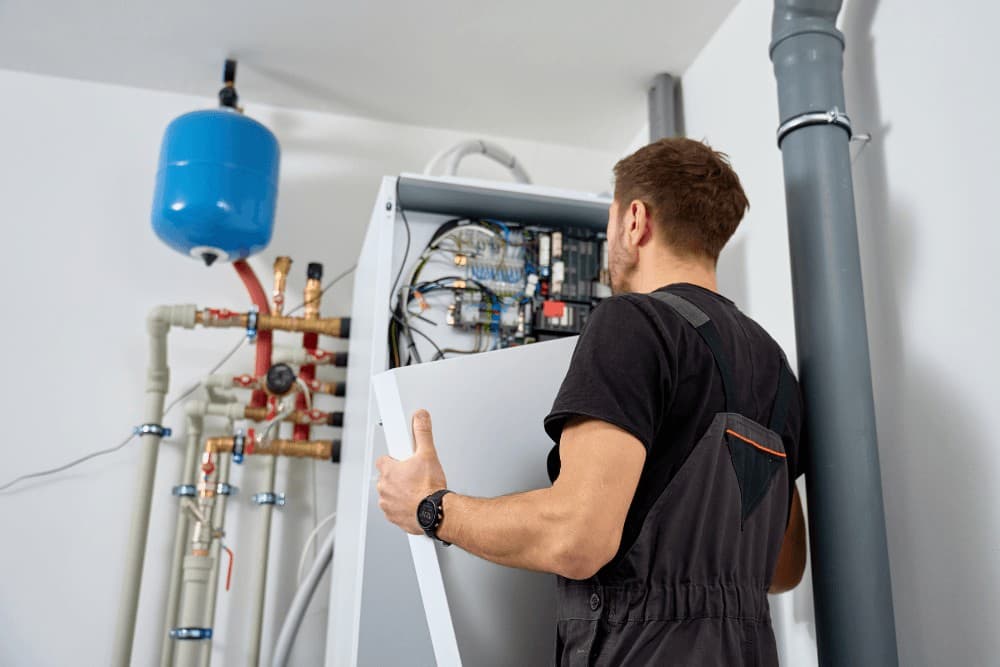
What Actually Happens on Installation Day
A water heater installation isn't a single task — it's sizing the unit to your household's real hot water demand, confirming the electrical or gas supply can actually support it, removing and disposing of the old unit if there is one, running or adapting the water, drain, and gas or electrical connections, and pressure-testing everything before we leave. Every step below is covered in the fixed price you're quoted after we've seen the installation location — not added as a surprise line item halfway through the job.
If you already have a water heater and it's misbehaving rather than needing to be replaced, our water heater repair page covers diagnosis and fault-by-fault pricing for existing units — this page is specifically about putting a new one in.
Choosing a Water Heater to Install
If you already know which type you want, skip ahead to pricing. If you're deciding, here's the honest trade-off on each — including the electrical detail most installers don't mention until after they've quoted.
Electric storage tank
The default choice for most Abu Dhabi apartments and villas
A 30–100 litre tank that heats and holds water, ready on demand. Simplest to install of the four options — no gas line, no special ventilation — and the widest range of sizes to match household demand. The trade-off is standby heat loss: it keeps a tank of water hot around the clock, whether you're using it or not.
Gas storage tank
Villas already on a gas line, or where running one is straightforward
Heats faster and recovers faster than electric after heavy use — useful for a household that runs through hot water quickly. Installation is more involved: it needs a certified gas connection and correct venting clearance to the outside, which is why gas units are less common in modern Abu Dhabi apartments than they were in older buildings.
Tankless / instant
Households wanting endless hot water and minimal standby energy use
Heats water on demand rather than storing it, so it never runs out mid-shower and takes up a fraction of the space of a tank. The catch, and it's a real one: a whole-house electric tankless unit needs several kilowatts of continuous power to heat water instantly rather than gradually, which usually means a dedicated double-pole breaker and heavier-gauge wiring than a standard socket circuit provides. This is the single most common reason a tankless installation costs more than a straight tank swap: it's rarely just the unit, it's often new dedicated wiring and breaker capacity too — worth having a technician check your consumer unit's spare capacity before you commit to tankless.
Solar water heater
Villas with usable, structurally sound roof space and southern sun exposure
A rooftop collector paired with a storage tank and backup electric element for overnight or overcast periods. Lower running cost over time, but the installation itself needs a roof access and structural assessment first — the collector and a full tank of water is genuine weight, and not every roof or parapet was built with that load in mind.
Heat pump water heater
Larger households wanting lower running costs than electric resistance heating
Extracts heat from surrounding air rather than generating it directly, using a fraction of the electricity of a standard electric tank for the same hot water output. Needs more physical space than a standard tank (for the compressor and air intake/exhaust), a location tolerant of the cool air it exhausts, and is a larger upfront cost — the running-cost savings are the case for it, not the purchase price.
What Size Do You Actually Need?
Undersizing is the single most common installation mistake we get called out to fix later — not a fault, just a tank that was never going to keep up with the household it was put into. This is a general starting guide, not a substitute for a technician confirming it against your actual bathroom count and usage pattern.
| Home type | Typical tank size | Why |
|---|---|---|
| Studio / 1-bedroom apartment | 30–50 litres | Covers one bathroom's typical shower and kitchen use without long recovery waits between uses. |
| 2-bedroom apartment | 50–80 litres | The most commonly installed size across Abu Dhabi apartments — comfortably covers two bathrooms used at different times. |
| 3-bedroom apartment / small villa | 80–100 litres | Needed once two bathrooms see genuinely overlapping use — back-to-back showers in the morning, for example. |
| Larger villa, multiple bathrooms | 100L+ per zone, or a central system | Often makes more sense as either multiple smaller units serving separate zones, or one central tank with a circulation pump — see the note below. |
Studio / 1-bedroom apartment
30–50 litres
Covers one bathroom's typical shower and kitchen use without long recovery waits between uses.
2-bedroom apartment
50–80 litres
The most commonly installed size across Abu Dhabi apartments — comfortably covers two bathrooms used at different times.
3-bedroom apartment / small villa
80–100 litres
Needed once two bathrooms see genuinely overlapping use — back-to-back showers in the morning, for example.
Larger villa, multiple bathrooms
100L+ per zone, or a central system
Often makes more sense as either multiple smaller units serving separate zones, or one central tank with a circulation pump — see the note below.
Tankless changes this calculation entirely
A tankless unit isn't sized in litres — it's sized by flow rate, in litres per minute, against how many outlets need hot water at the same time. A single-bathroom household needs far less flow capacity than a villa where a shower, the kitchen tap, and a washing machine's hot fill might all draw at once. Undersizing a tankless unit for simultaneous demand is a real and common complaint — hot water at one tap suddenly running lukewarm the moment a second tap opens — so this is a calculation worth having a technician do properly rather than guessing from the litres-based table above.
What Needs to Be in Place Before Installation
This is the part most installation quotes skip past — and the most common reason a quoted price turns out to be incomplete once work actually starts. We check these on the initial visit or call, not discover them mid-job.
Electrical capacity (electric & tankless units)
A standard electric storage tank runs on a normal dedicated circuit in most cases. A tankless unit is a different question — it typically needs a dedicated double-pole breaker and heavier-gauge wiring than the socket circuits most homes already have. We check your consumer unit's spare capacity before quoting a tankless installation, rather than after, so there's no surprise electrical-work line item once the job is underway.
Gas connection & venting (gas units)
A gas water heater needs a certified gas line connection and correct venting clearance to route combustion byproducts safely outside — this is not a job for anyone other than a licensed technician, and it's the main reason gas installations take longer to schedule than electric ones. If your building doesn't already have a gas supply run to the installation point, that's a separate scope of work to price before the water heater itself goes in.
Water supply, drainage & pressure relief discharge
Every tank needs a cold water supply, an isolation valve so it can be shut off independently for future maintenance, and — critically — a proper discharge route for the pressure relief valve, so that if it ever needs to release pressure, it does so safely to a drain rather than into a cupboard or onto a ceiling below. This last point is one we see skipped on DIY and budget installs more than any other.
Roof access & structural check (solar units)
A rooftop collector plus a full tank of water is real, concentrated weight on a roof or parapet area that wasn't necessarily designed to carry it. We check access and structural suitability before installation day, not as an afterthought — this is also why solar installation quotes vary more than tank or tankless quotes, since every roof is different.
Building management approval (apartments)
Many apartment buildings in Abu Dhabi require notifying or getting sign-off from building management before drilling, running new lines, or working in shared risers or utility cupboards — particularly for anything touching the building's gas supply or exterior venting. Confirming this before installation day avoids a wasted first visit; if you're unsure, ask us when you book and we'll tell you what's typically needed for your building type.
The Installation Process, Step by Step
Six steps, all covered in one visit for a standard swap-in-place job. Gas and solar installations sometimes need a separate assessment visit first — we'll tell you upfront if yours does.
- 1
Assessment & sizing
We confirm household size, bathroom count and usage pattern, existing electrical/gas supply, and installation location before quoting — over the phone for straightforward swaps, on-site for anything involving a new type of unit or a location change.
- 2
Old unit removal (if replacing)
The old tank is drained, disconnected, and removed. If it's a tank-body leak or heavy corrosion, we handle this carefully given the weight of a full or near-full tank — this is a two-person job on larger units, not a one-person task rushed to save time.
- 3
Positioning & clearance
The new unit is positioned for correct clearance — venting distance for gas, dry accessible space for electrical connections, structural support for anything wall- or ceiling-mounted — and for practical future access, since every unit eventually needs a service visit.
- 4
Connections
Water supply, isolation valve, drainage, and the gas or electrical connection are made to code, followed by the pressure relief valve's discharge line — routed to a proper drain point, not left to discharge into the installation cupboard.
- 5
Pressure testing & safety check
Every connection is pressure-tested before we consider the job done. Gas units get a leak check at every joint; electric units get a check that the circuit is drawing correctly and the breaker is appropriately rated, not just that the unit switches on.
- 6
Temperature setting & handover
The thermostat is set to a temperature that balances comfort against scald risk and mineral scaling — not left at a factory default that's often higher than necessary — and we walk you through the isolation valve location and basic maintenance before we leave.
Fresh Install vs. Swap-in-Place
"Water heater installation" covers two genuinely different jobs, and the price difference between them is almost always about access and connections, not the unit itself.
Swap-in-place replacement
Water, drain, and gas or electrical connections already exist at the location — the new unit connects to what's already there. This is the faster, more predictable job, usually completed in one visit, and it's what most replacement calls turn out to be.
First-time / new-location install
No existing connections at the chosen spot — common in a newly handed-over villa, a converted utility space, or moving the unit to a better location. This needs new plumbing, and potentially new electrical or gas runs, which is genuinely more work and priced accordingly after we've seen the space.
Changing type during a replacement
Replacing a tank with another tank of the same type is the simplest version of this job. Switching from tank to tankless, or from electric to gas, at the same time as a replacement is closer to a first-time install than a swap — the existing connections were built for the old unit's requirements, not the new one's, so expect the requirements checklist above to apply in full.
Installation Mistakes We See Most Often
Most of these come from budget installs done in a hurry, or a DIY attempt on a job that genuinely warrants a licensed technician. None of them show up on day one — they show up as a complaint six months to two years later.
Undersizing for the household
The single most common issue we're called out to fix after someone else's installation, or a unit installed when the home had fewer occupants. Running out of hot water partway through a shower routine most mornings is almost always a sizing problem, not a fault.
No isolation valve fitted
Without one, any future maintenance or repair means shutting off water to the whole property rather than just the unit. It costs very little to fit at installation time and is genuinely inconvenient to retrofit later.
Pressure relief valve discharge routed nowhere useful
The valve exists to release pressure safely if the tank overheats. If its discharge line ends in a cupboard, over storage, or isn't routed to a drain at all, the safety feature exists on paper but not in practice.
Tankless installed without checking electrical capacity first
Covered in detail above — this is the fastest way an installation quote balloons mid-job, when the electrician discovers the existing panel can't support the new unit's draw after it's already been mounted.
Gas venting clearance ignored to save space
Tight utility cupboards tempt a shortcut on venting clearance. This isn't a cosmetic requirement — it's how combustion byproducts escape safely rather than building up in an enclosed space.
Skipping the old unit's proper disposal
A drained tank still weighs a significant amount and often contains sediment and, on older units, water that hasn't fully drained. Removing it safely — and disposing of it responsibly rather than leaving it for the building's waste area to deal with — is part of a proper installation job, not an optional extra.
Water Heater Installation Cost in Abu Dhabi
Total cost is labor plus the unit itself, and the two are worth separating — most quotes that look confusing are really just bundling them without saying so. You can supply your own unit, or we can supply and fit one; either way, here's both halves broken out.
Installation labor
| Job | Labor price | Note |
|---|---|---|
| Standard installation labor (swap-in-place, electric tank) | AED 300 – 600 | Excludes unit cost |
| Standard installation labor (gas tank) | AED 400 – 900 | Includes gas connection & venting check; excludes unit |
| Tankless installation labor | AED 700 – 1,200 | Includes wiring assessment; new dedicated circuit priced separately if needed |
| Solar water heater installation labor | AED 500 – 1,200 | After roof access & structural assessment; excludes unit |
| First-time install / new location (any type) | AED 600 – 1,800+ | New plumbing and/or electrical/gas runs required |
| Old unit removal & disposal | Included | When installing a replacement |
| Ceiling/structural access work, if needed | AED 500 – 1,500 | Only where the location requires it |
Standard installation labor (swap-in-place, electric tank)
AED 300 – 600
Excludes unit cost
Standard installation labor (gas tank)
AED 400 – 900
Includes gas connection & venting check; excludes unit
Tankless installation labor
AED 700 – 1,200
Includes wiring assessment; new dedicated circuit priced separately if needed
Solar water heater installation labor
AED 500 – 1,200
After roof access & structural assessment; excludes unit
First-time install / new location (any type)
AED 600 – 1,800+
New plumbing and/or electrical/gas runs required
Old unit removal & disposal
Included
When installing a replacement
Ceiling/structural access work, if needed
AED 500 – 1,500
Only where the location requires it
Typical unit cost (if you'd like us to supply)
| Unit type | Typical unit price |
|---|---|
| Electric storage tank, 30–80L (unit only) | AED 500 – 1,250 |
| Electric storage tank, 100L+ (unit only) | AED 900 – 1,800 |
| Tankless / instant unit (unit only) | AED 350 – 2,200 |
| Solar water heater system (unit only) | AED 1,500 – 5,000+ |
Electric storage tank, 30–80L (unit only)
AED 500 – 1,250
Electric storage tank, 100L+ (unit only)
AED 900 – 1,800
Tankless / instant unit (unit only)
AED 350 – 2,200
Solar water heater system (unit only)
AED 1,500 – 5,000+
Fixed price confirmed before we start
Once we've assessed the location and confirmed the unit, the total — labor and unit, itemized separately — is agreed before any work begins. Nothing changes after that unless you ask for something additional.
* Prices are in AED and are typical ranges for Abu Dhabi installations, inclusive of VAT where applicable. Your exact price is confirmed after we've seen the installation location.
Brands We Install
We install new units from most brands sold in the UAE, and we're also happy to fit a unit you've already bought yourself — the installation labor pricing above applies either way.
Ariston
The most commonly requested brand for new installations in Abu Dhabi, across both electric storage and instant/tankless ranges. Familiarity with Ariston's specific mounting brackets and connection layouts means a first-visit installation in most cases, without waiting on a return trip for the right fitting.
Also installed: Bajaj, Racold, Havells, Crompton, Kwikot, Joven, V Guard, and most other electric, gas, tankless, and solar water heater brands available in the UAE market. If you've already chosen a specific model, mention it when booking so we can confirm mounting and connection requirements in advance.
After Installation: What to Check and When
A properly installed water heater doesn't need attention immediately — but a little maintenance in the first year meaningfully changes how long it lasts before you're back to this page reading about replacement instead.
First month
Check the installation area for any dripping or dampness once the unit has been running under normal use for a few days — a slow leak at a connection is easiest to catch and fix early, before it causes any real damage.
First year
A tank unit's first anode rod check is worth doing around the 12-month mark in Abu Dhabi's water conditions, sooner than the 2-3 years sometimes quoted for milder water elsewhere. This is a small, inexpensive check that meaningfully extends tank life.
Ongoing
A tank flush every 6-12 months to clear sediment buildup is the single most effective thing you can do to keep both performance and lifespan on track — this is covered in more detail on our water heater repair and maintenance page.
Villa central systems need one extra check
If your installation is a central system feeding multiple bathrooms, the circulation pump is worth a listen for unusual noise in the first few weeks — it runs far more often than a single-outlet unit's components, so it's also the part most likely to show early signs of an installation issue, such as trapped air in the line, before anything else does.
Areas We Cover in Abu Dhabi
We install water heaters across Abu Dhabi, for apartments, villas, and offices alike. Don't see your area listed? Call to confirm — we likely cover it.
How Booking Works
- 1
Call or book online
Tell us the unit type you want (or already have), and whether it's a swap or a first-time install.
- 2
Sizing & assessment
Over the phone for a straightforward swap, on-site for anything involving new connections or a location change.
- 3
Installation & pressure test
Usually one visit; you get a fixed price, itemized as labor and unit, before we start.
Frequently Asked Questions
How much does water heater installation cost in Abu Dhabi?
Do you offer same-day water heater installation?
Can I install my own water heater and just have you connect it?
Is a permit or building management approval needed to install a water heater in my apartment?
What size water heater do I need?
Is tankless installation more expensive than a standard tank?
Do you install solar water heaters?
Do you remove and dispose of my old water heater?
What's the difference between installing a water heater and repairing one?
Is there a warranty on the installation?
Do you install gas water heaters, or only electric?
Can you install a water heater in a villa's central hot water system?
Can I switch from electric to gas (or gas to electric) when replacing my water heater?
How long does a typical water heater installation take?
Do I need to be home during the installation?
Ready When You Are
Installing a new water heater? Book a technician today.
Fixed price confirmed before any work starts. Licensed technicians, 90-day workmanship warranty.