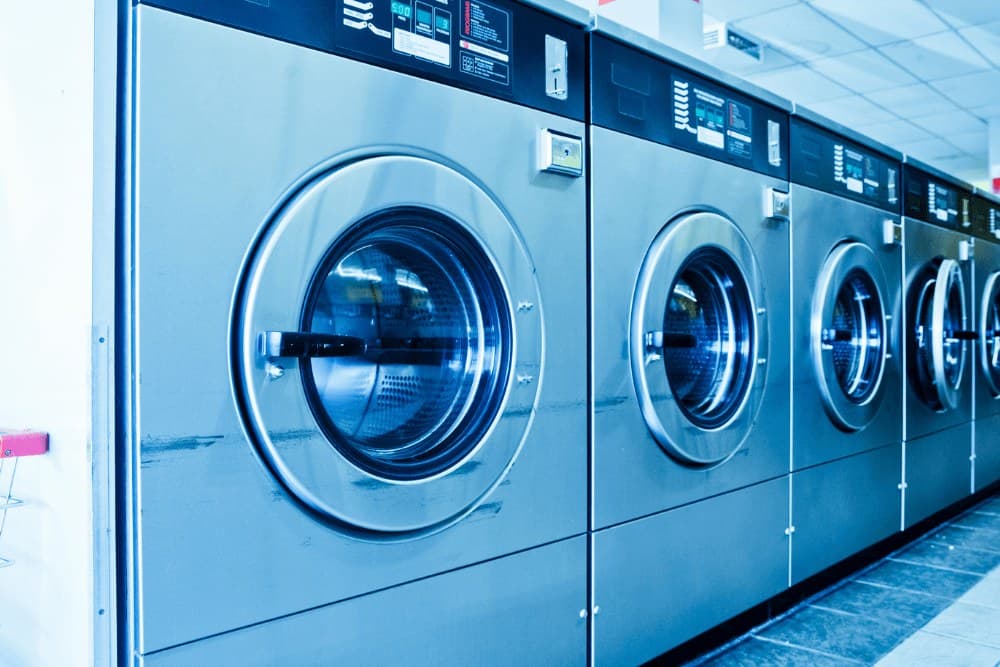
Laundromats · Hotels · Building Laundry Rooms · Coin-Op
Commercial & Industrial Laundry Equipment Repair in Abu Dhabi
A commercial washer or dryer down isn't a household inconvenience — it's a machine that's supposed to be earning money or clearing linen turnover, sitting idle instead. We repair coin-operated, card-operated, and standard commercial washers, dryers, and extractors for laundromats, hotels, building management companies, and staff accommodation laundry rooms across Abu Dhabi.
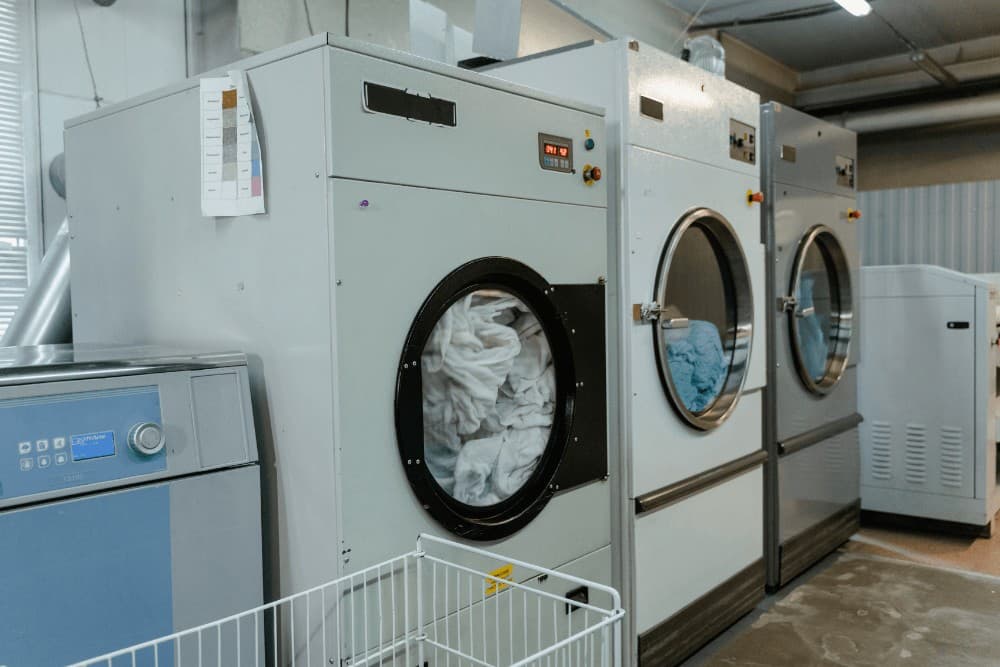
Who This Service Is For
This is a different service from household washing machine repair — commercial and industrial units run far more cycles per week, often use different control systems and coin or card payment mechanisms, and a fault usually needs fixing the same day, not "whenever's convenient."
Laundromats & self-service laundry shops
Coin-operated and card-operated washers and dryers in continuous public use, where a broken machine is lost revenue every hour it's out of service, not just an inconvenience.
Hotels & serviced apartments
Back-of-house laundry rooms handling linen, towels, and guest laundry on a schedule that can't slip — a down machine during high occupancy backs up the entire operation.
Building management & staff accommodation
Shared laundry rooms serving a tower, labor accommodation block, or staff housing compound, where dozens of residents depend on a small number of machines staying operational.
Gyms, spas & facilities with towel service
Smaller-scale but frequent-use commercial washers and dryers handling towel and uniform laundry, typically running longer daily cycles than a household machine is built for.
If your setup doesn't fit any of these but you're running more than a household amount of laundry through a machine — a small guesthouse, a nursery or daycare handling linen in-house, a salon with a towel-washing routine — the same repair and maintenance approach applies. The distinction that matters isn't the business category, it's whether the machine is running at commercial cycle volume, since that's what determines both the failure patterns and the urgency.
Brands & Machine Types We Service
Speed Queen, Electrolux Professional, and Girbau make up most of the commercial washer/dryer fleet across UAE laundromats and hotel back-of-house laundry rooms, with IPSO and Primus common in older installations — we work on all of them, plus the commercial lines from the residential brands below.
Front-load, top-load & industrial extractors
Coin and card-operated front-load washers are the most common configuration in UAE laundromats; hotels and staff accommodation more often run larger-capacity top-load or industrial extractor units for bulk linen and uniform loads. The two categories fail differently — front-load commercial units share more with heavy-duty residential mechanics, while industrial extractors have their own bearing, drive-belt, and high-speed spin-cycle failure points that a household appliance technician typically hasn't worked on. Dryers follow a similar split: standard commercial tumble dryers handle laundromat and small-hotel volume fine, while a large hotel's linen operation more often runs a dedicated high-capacity or gas-fired industrial dryer with its own burner and airflow characteristics.
Common Commercial Washer Faults
High cycle counts mean commercial washers fail in patterns that are fairly predictable once you've seen enough of them — the six below cover most of the call-outs we get.
Won't start or coin/card mechanism not registering payment
Often the payment mechanism itself rather than the machine — a jammed coin acceptor, a card reader that's lost its network connection, or a control-board fault that isn't receiving the start signal from the payment unit at all.
Not filling, or filling very slowly
In high-cycle commercial use, inlet valve screens clog with mineral sediment far faster than in a household machine — usually the first thing checked, before assuming the valve itself has failed.
Excessive vibration or walking during spin
Commercial washers are bolted or anchored to the floor specifically because of the forces at high-capacity spin speeds; a loosened anchor bolt or worn suspension component shows up as vibration long before it causes a bigger failure.
Door lock or interlock fault
Heavy daily door-cycle use wears the interlock mechanism faster than residential use ever would — a common fault on machines running 15+ cycles a day, and usually a straightforward part replacement.
Water leaking from the door seal
A commercial front-load gasket sees far more open/close cycles and detergent exposure than a household one; replacement is routine maintenance on a high-cycle machine, not a sign of a bigger problem.
Drum not spinning or spinning at the wrong speed
Drive belt wear, a failing motor, or (on card-operated commercial units) a control-board fault tied to the cycle-selection logic rather than the motor itself.
Common Commercial Dryer Faults
Commercial dryers run longer cycles and higher daily volume than household units, which shifts the common failure points toward heat delivery and airflow rather than the drum mechanics themselves.
Not heating, or heating inconsistently
Commercial gas dryers rely on an igniter and gas valve that see far more ignition cycles than a household unit; electric commercial dryers more often fail at the heating element or thermal cutoff switch. Either way, this is the single most common commercial dryer complaint we see.
Long dry times / clothes coming out damp
Almost always restricted airflow — a clogged lint screen or, more often in commercial installations, a vent duct that's accumulated lint over months of heavy daily use and was never on anyone's cleaning schedule.
Drum not turning
Drive belt failure from cycle-count wear, or a failing motor — commercial dryer motors are built to handle more use than residential ones but still have a service life measured in cycles, not years.
Coin/card mechanism accepting payment but not starting the cycle
A control-board or timer fault separate from the payment mechanism itself — diagnosed by testing the start circuit independently of the coin drop or card swipe.
Burning smell
Treat this as urgent, not routine — usually lint buildup near the heating element or a duct restriction causing heat to build up inside the drum rather than exhaust properly. Worth shutting the unit down and calling immediately rather than running another cycle.
Coin, Card & Prepaid Payment System Repair
A laundromat machine that's mechanically fine but won't take payment is just as out of service as one with a broken motor — and it's a genuinely separate repair skill from the washer or dryer itself.
Coin acceptors jam or miscalibrate over time, especially with heavy daily use and the range of coin conditions that pass through a public machine. Card and prepaid-tag systems fail differently — usually a network or connectivity issue between the reader and the machine's payment processor, a firmware fault, or a reader unit that's physically worn from thousands of taps and swipes.
The first diagnostic step is always isolating which system is actually at fault — payment mechanism or the washer/dryer's own control board — since a machine that accepts payment but doesn't start could be either, and troubleshooting the wrong one wastes a visit. We test the start-signal circuit independently of the payment unit to identify which side of the fault sits on before opening anything up.
We don't reprogram pricing or manage the backend of a card payment network — that's between you and your payment system provider — but we can diagnose and repair the physical reader or coin mechanism hardware and confirm it's communicating correctly with the machine, which covers the vast majority of "payment accepted, machine won't start" call-outs we see.
Dryer Vent Safety Isn't Optional at Commercial Volume
Lint is flammable, and a commercial dryer running a dozen or more cycles a day produces far more of it than any residential cleaning schedule anticipates. This is a genuine fire-risk item in a laundromat or a building laundry room, not just a maintenance nicety, and it's one of the most overlooked items on any commercial site's checklist.
Abu Dhabi and Dubai commercial premises fall under civil defence fire and life-safety requirements that expect mechanical ventilation and exhaust systems — which includes commercial dryer venting — to be maintained and kept clear of obstruction. A laundry room that's part of a licensed commercial premises (a laundromat, a hotel back-of-house area, a building's shared facilities) should treat vent cleaning as a compliance item, not an optional extra, and it's worth confirming with your building's facilities or fire safety contact what inspection schedule applies to your specific setup.
Practically, this means checking and clearing the vent duct — not just the lint screen inside the machine — on a schedule tied to actual usage volume rather than a fixed annual date. A six-machine laundromat running most machines multiple times daily needs this checked far more often than a lightly used building laundry room with two machines. We include duct inspection in every maintenance contract tier for exactly this reason, and can do a standalone vent clearing and inspection visit if you're not on a contract but have noticed longer dry times or haven't had it checked recently.
Hard Water Shortens Commercial Machine Life Here
Desalinated municipal water across Abu Dhabi and Dubai runs harder than many operators expect, and at commercial cycle volumes, the mineral scale buildup this causes shows up as equipment failure far sooner than the same machine would fail in a lower-mineral-content market.
Scale accumulates inside inlet valves, heating elements, and internal water lines. On a household machine doing a handful of cycles a week, this is a slow process. On a commercial washer running fifteen or more cycles a day, the same buildup happens in a fraction of the time — which is a large part of why inlet valve screens are the single most common item flagged on our maintenance visits, and why heating elements on commercial water heaters and dryer components fail more often here than equivalent equipment in softer-water markets.
Operators running a laundromat or a hotel laundry room at real volume see a measurable return from a point-of-use water softener or scale-inhibitor fitted ahead of the machines — it doesn't eliminate maintenance, but it meaningfully extends the interval between inlet valve and heating element failures. If you're not sure whether your site has one installed, it's worth checking during your next maintenance visit, since it's often the difference between quarterly and twice-yearly inlet valve service, and the fitting cost is usually recovered within a year or two through fewer call-outs alone.
Why Response Time Matters Here More Than Usual
A household washing machine sitting broken for three days is an inconvenience. A laundromat machine sitting broken for three days is three days of direct lost revenue on that unit, and a hotel laundry room down during high occupancy is a backlog that doesn't just disappear once the machine's fixed — it has to be worked through, load by load, on top of the next day's normal volume.
Same-day response, most cases
For laundromats and hotels, we prioritize commercial call-outs and aim for same-day attendance rather than queuing them behind residential jobs booked earlier.
Diagnosis before parts ordering
We confirm the actual fault on the first visit wherever possible so any parts order is for the right component, rather than a guess that costs another visit's worth of downtime.
Multi-unit sites triaged by impact
If your site has several machines and only one is down, that's a different urgency than a two-machine laundromat with one out of service — tell us your total machine count when you call so we can prioritize accordingly.
Service Contracts for Multi-Machine Sites
Laundromats, hotels, and building management running more than a couple of machines generally do better on a scheduled maintenance contract than waiting for breakdowns — the failure points above (inlet screens, anchor bolts, vent ducts, door seals) are almost all catchable before they cause a call-out.
Basic
2 visits / year
Inlet valve screen cleaning, door seal inspection, anchor bolt check, vent duct inspection on dryers.
Standard
Quarterly
Everything in Basic, plus drive belt and bearing wear check, payment mechanism function test, and priority scheduling for repair call-outs.
Comprehensive
Monthly + on-call
Everything in Standard, plus a dedicated response-time commitment for breakdowns and a named technician familiar with your specific site and machine fleet.
Contract pricing scales with machine count and tier — a six-machine laundromat and a sixty-machine staff accommodation block are priced very differently. Call for a quote based on your actual site.
A Realistic Maintenance Schedule
This is roughly what a well-maintained commercial site actually does, split between what site staff can handle daily and what needs a technician on a set schedule. Our service contracts above are built around this same structure.
| Task | Frequency | Who does it |
|---|---|---|
| Lint screen cleaning (dryers) | Daily | Site staff |
| Vent duct inspection & clearing | Monthly (high-volume) / quarterly (low-volume) | Technician |
| Inlet valve screen cleaning | Quarterly | Technician |
| Door seal & gasket inspection | Quarterly | Technician |
| Anchor bolt tightness check | Twice yearly | Technician |
| Drive belt & bearing wear check | Twice yearly | Technician |
| Payment mechanism function test | Quarterly | Technician |
| Water softener / scale-inhibitor check | Twice yearly | Technician |
Lint screens are the one item on this list that shouldn't wait for a scheduled visit — it takes site staff seconds after each load and meaningfully reduces both fire risk and dry times between technician visits. Everything else on this list is included across our maintenance contract tiers, scaled by how often your specific site actually needs it, rather than a one-size-fits-all annual visit that doesn't match real usage.
Emergency Call-Out vs. Scheduled Repair
Not every fault needs a same-day emergency visit, and being upfront about that saves you a priority call-out fee on jobs that genuinely don't need one.
| Factor | Emergency call-out | Scheduled repair |
|---|---|---|
| Response | Same day, priority over scheduled jobs | Booked appointment window, usually within a few days |
| Best for | A machine down and generating no revenue right now | A minor fault that hasn't taken the machine fully offline (noise, slow drying, minor leak) |
| Pricing | Standard rate plus a priority call-out fee | Standard rate, no priority premium |
| Typical examples | Won't start, burning smell, won't drain, payment system fully down | Vibration getting worse, longer dry times than usual, occasional error codes |
Tell us honestly whether the machine is fully out of service or just showing an early symptom — we'll recommend which category your job falls into rather than defaulting to the higher-cost option.
Parts Availability & Repair Timelines
How fast a repair can actually be completed often comes down to whether the failed part is stocked locally or needs ordering — worth knowing upfront rather than assuming every repair finishes in one visit.
Speed Queen and Electrolux Professional are common enough in the UAE market that standard wear parts — door seals, inlet valves, drive belts, control boards for popular models — are typically available locally within a day or two. Girbau, IPSO, and Primus units, especially older installations, more often need a part ordered from a regional distributor, which can extend a repair to several days rather than a single visit.
On the first visit, we diagnose the fault and tell you honestly whether the part is something we can fit same-day or something that needs ordering, along with a realistic timeline. For laundromats and hotels where downtime has a direct cost, this is also where a service contract earns its keep — a site we maintain regularly is one where we already know the machine fleet and can often anticipate which wear parts are likely to need replacing soon, rather than discovering it mid-breakdown.
If a part's lead time would leave a laundromat's only washer of a given size out of service for an extended period, we'll flag that clearly so you can decide whether a temporary workaround (routing loads to other machines, adjusting capacity, or a short-term rental unit) makes sense while the part is in transit, rather than just waiting it out with no plan.
Opening a New Laundromat or Relocating Equipment
Repair is most of what we do on this page, but a fair amount of commercial laundry work is actually installation — fitting out a new laundromat, moving machines to a different unit, or adding capacity to an existing site.
New site fit-out
Water supply, drainage, and electrical connections for a full bank of commercial machines, including the higher amperage circuits commercial dryers typically need compared to residential ones.
Equipment relocation
Disconnecting, moving, and reinstalling existing machines to a new unit or a reconfigured layout — including re-leveling and re-anchoring, which matters more for commercial units than most people expect given the forces involved at high spin speeds.
Capacity expansion
Adding machines to an existing site — checking whether the current water, drainage, and electrical infrastructure can actually support the additional load before installation day, not after.
If you're planning a new laundromat or expanding an existing one, call before you've committed to a layout — a quick conversation about your water and electrical supply, and where the dryer venting will actually run, can avoid a costly redesign after the machines have already arrived on site.
Commercial Laundry Repair Cost in Abu Dhabi
Commercial and industrial repairs cost more than household appliance repair because the parts, motors, and diagnostic work involved are built to a heavier-duty standard — here's roughly where jobs land.
| Job | Price | Note |
|---|---|---|
| Diagnostic / site visit | AED 150 – 250 | Waived against the repair cost if you proceed |
| Commercial washer repair (standard fault) | AED 300 – 700 | Inlet valve, door seal, drive belt, control board |
| Commercial dryer repair (standard fault) | AED 300 – 650 | Heating element, igniter, vent duct clearing |
| Industrial extractor / high-capacity unit repair | AED 500 – 1,200 | Bearing, drum, or drive-system work |
| Coin/card payment mechanism diagnosis & repair | AED 250 – 600 | Hardware only, not backend payment network configuration |
| Emergency same-day call-out | +AED 150 – 300 | Priority fee on top of standard repair rate |
| Service contract (per machine, per year) | Quoted by site | Scales with machine count and tier — see contracts below |
Diagnostic / site visit
AED 150 – 250
Waived against the repair cost if you proceed
Commercial washer repair (standard fault)
AED 300 – 700
Inlet valve, door seal, drive belt, control board
Commercial dryer repair (standard fault)
AED 300 – 650
Heating element, igniter, vent duct clearing
Industrial extractor / high-capacity unit repair
AED 500 – 1,200
Bearing, drum, or drive-system work
Coin/card payment mechanism diagnosis & repair
AED 250 – 600
Hardware only, not backend payment network configuration
Emergency same-day call-out
+AED 150 – 300
Priority fee on top of standard repair rate
Service contract (per machine, per year)
Quoted by site
Scales with machine count and tier — see contracts below
Fixed quote after diagnosis, before any repair starts
For multi-unit sites, ask about a per-machine service contract rate instead of pricing each breakdown individually.
* Prices are in AED and are typical ranges for Abu Dhabi, inclusive of VAT where applicable. Your exact price is confirmed after diagnosis.
Areas We Cover in Abu Dhabi
We service commercial and industrial laundry equipment across Abu Dhabi, including laundromats, hotels, and building laundry rooms. Don't see your area listed? Call to confirm — we likely cover it.
How Booking Works
- 1
Call and describe the fault
Machine type, brand if known, and how many units are affected — this decides whether it's an emergency or scheduled visit.
- 2
We diagnose and quote on-site
Fixed price for the repair confirmed before any work starts, factoring in your machine type and fault.
- 3
Repair, or a service contract conversation
One-off fix for a single fault, or a scheduled maintenance plan if you're running multiple machines.
Frequently Asked Questions
Do you repair coin-operated washing machines?
Do you service commercial laundry equipment for laundromats?
What brands of commercial laundry machines do you repair?
Do you repair industrial laundry equipment, not just standard commercial machines?
Do you fix hotel laundry room equipment?
How quickly can you respond to a broken commercial washer or dryer?
Do you offer maintenance contracts for multi-machine sites?
Why is my commercial dryer taking much longer to dry than it used to?
Can you repair the card payment system on a laundry machine, not just the mechanical parts?
Do you repair laundry equipment in staff accommodation or labor camp laundry rooms?
Do you repair Speed Queen commercial washers?
How long does a commercial washer or dryer repair usually take?
Do you work on machines at guesthouses, salons, or small businesses that aren't full laundromats?
How often should commercial laundry equipment be serviced?
Can you install new commercial washers and dryers for a laundromat I'm opening?
Why do commercial machines break down more often in the UAE than expected?
Is dryer vent cleaning actually necessary, or just recommended?
What's the difference between an emergency call-out and a scheduled repair?
Ready When You Are
Commercial washer or dryer down? Get a technician on-site today.
Fixed price confirmed before any work starts. Licensed technicians, 90-day workmanship warranty.